
Plastic
Nutrition documentaries, environmental awareness documentaries, fishing and agricultural industry documentaries, I've watched most of the ones Netflix has to offer but not A Plastic Ocean in Garuda Indonesia's film menu. My jaw dropped at some of the statistics found by studies, for instance that 83 percent of 159 tap water samples worldwide tested positive for microscopic plastic fibers.
We currently produce more than 322 million tons of plastic each year, the equivalent in weight of 46 Great Pyramids of Giza and more than the entire world population on a scale, which weighs in at 287 million tons according to The New Scientist. The estimated 8 million tons of plastic that end up in the ocean every year photo-degrade to tiny pieces under the action of salt and churning water combined with UV light exposure, described as microplastics when under 5mm in diameter. A trillion of these are locked in the melting Arctic icecap, in some cases more concentrated than the infamous Pacific gyre or garbage patch. What happens when over the next few years, with temperatures continually on the rise, the Arctic ice releases the trapped fragments? They will join the trillion more afloat on the ocean surface and the soupy collection clouding below.

But plastic omnipresence isn't confined to oceans and rivers, it seems, since research found microscopic plastic fibres in tap water from Trump Tower in Manhattan to Beirut to Kampala, Uganda. Drinking the recommended two litres of water exposes every one of us to an average eight plastic fibres a day, more than 2,900 each year and that excludes the tap water used in the dough for daily bread, to cook rice and wash vegetables. Also not taken into account in this statistic are the plastic particles found in seafood, the epitome of which were the 80 percent of contaminated blue mussels measured off the coasts of France, Belgium and the Netherlands.
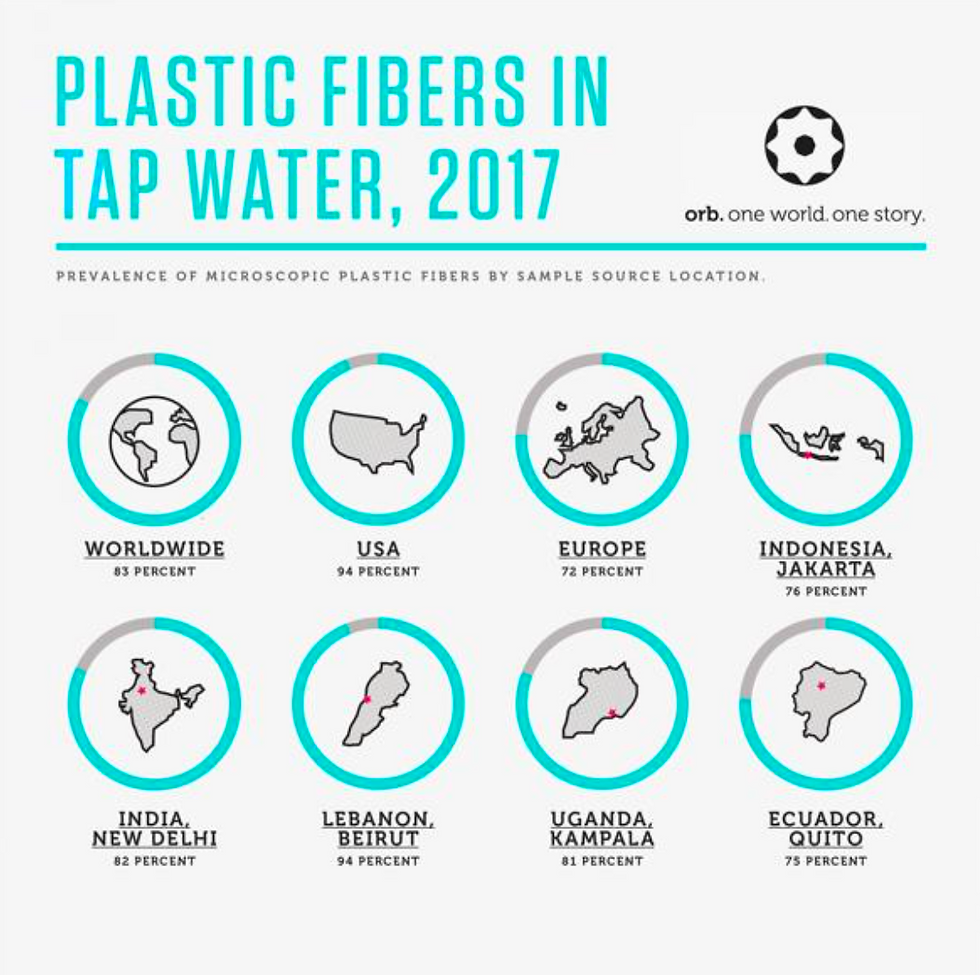
So how do plastic fibres make it into water systems? In recent years, progress has been made to recycle the many plastic bottles we discard after single-usage into fleece jumpers, mountain gear or trainers, which I thought to be a solution before I read the Orb report. Additionally, a bigger portion of our clothing is manufactured using firsthand synthetic textiles such as polyester and acrylic. With every rotation of our washing machines, synthetic clothing sheds plastic fibres so tiny wastewater plants can only filter out a maximum of 92 percent of them. Based on the tap water samples above, that figure probably applies to regulated European plants; in other parts of the world as many as 35 percent of particles might swim straight through the filters. New York city draws its water from the Catskill mountains and yet all samples tested positive for plastic fibres, suggesting that the atmosphere is somehow also peppered with particles. In the same way that a cat looses its hair, clothing, furniture and who knows what else emits plastic that hovers around us. The next challenge for scientists is to find out how plastic fibres get as far as the aquifers supplying Jakarta.

We have all heard of the evil bisphenol A or BPA so it will come as no surprise that the plastic fibres we ingest leach not only their own chemical ingredients but also the toxins absorbed from polluted water. According to Richard Thompson at Plymouth University, our gut even facilitates their rapid release in our tissue. I want to write "use containers to store leftover food instead of tearing off a sheet of clingfilm" but which of the two would harm you more if the tupperware leaks endocrine-disrupting chemicals into your ratatouille?
The predicted statistics if we do not alter our habits are truly horrifying. By the time I reach thirty, plastic production will have doubled and the ratio of plastic to fish in oceans will be 1 to 2. I highly recommend watching A Plastic Ocean as it ends on a somewhat positive note, which I haven't in this post as it is very likely we don't even realise half the scope of the plastic epidemic (exposure to nano-scale particles is a blind zone). In Sri Lanka and now Indonesia where a sweet wrapper is discarded without a care on the side of the road, I understand environmental concerns aren't the immediate priority for most but if we don't want to drown in plastic, it's now or never.
Full Orb report: https://orbmedia.org/stories/Invisibles_plastics/text
Plastic off the coast of Bali: https://www.youtube.com/watch?v=ArYLGNe-jCA
Sascha xx


Commentaires